

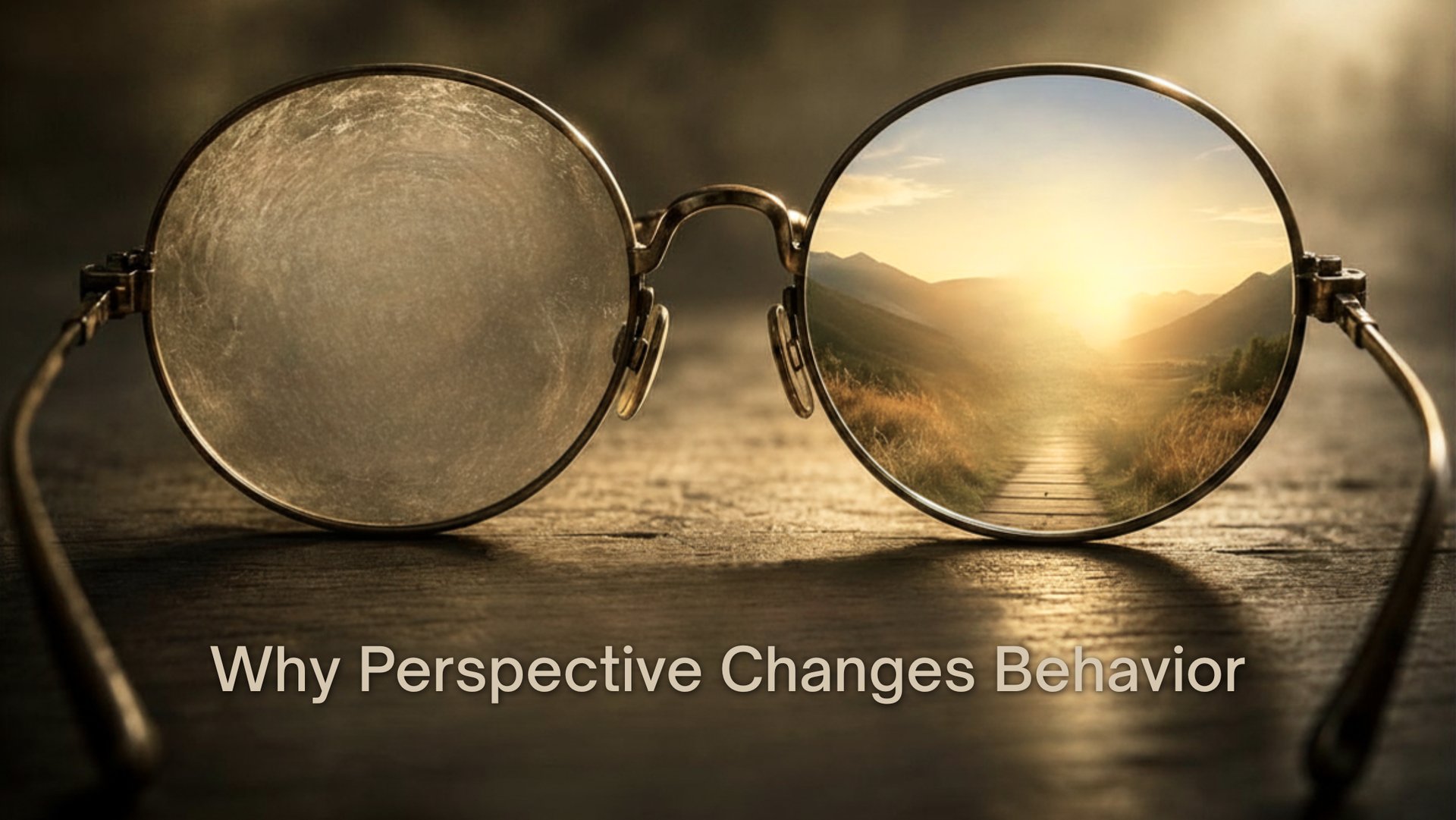
Why Perspective Changes Behavior
Why do two people experience the same training, yet walk away with completely different outcomes? The difference often isn't the training or the skill itself. It's the perspective each person brings into the experience. Explore why lasting Professional Development begins by examining the beliefs that quietly shape our behavior.
For years, I’ve used a simple analogy during leadership development workshops.
Imagine a snake suddenly drops from the ceiling and lands on the conference table.
Some people would instinctively run. Some would freeze. Some would become curious. And there's a good chance one person would calmly explain that it's harmless.
The snake didn't change. The reactions did. Why? Because none of us reacts to the snake itself. We react to the meaning we've assigned to the snake. That meaning is shaped by beliefs we’ve developed through our upbringing, experiences, education and environments... or simply the unknown.
Here's what I've observed. We usually don’t just react to similar events that way once. We repeat the pattern until we question the perspective that created it.
Recently, while reading James Clear’s weekly Atomic Habits newsletter he shared a simple thought on seeking results that caught my attention.
“Everyone wants better results.
Skill precedes results.
Practice precedes skill.
Attitude precedes practice.”
I found myself nodding in agreement; he had articulated something that connected beautifully with what I'd been teaching for years.
What precedes attitude?
Two leaders receive the same feedback.
One becomes defensive.
The other becomes curious.
Two employees experience a setback.
One sees failure.
The other sees a lesson.
Two organizations introduce significant operational change.
One group resists.
The other leans in.
The circumstances are often the same. The response is not. So what changed? I don't think it was attitude. I think it was perspective.
When I look back over my own career, I can see this pattern everywhere.
There was a time when I believed every accomplishment would finally prove I was enough. That perspective fueled an incredible work ethic, but it also created exhaustion because every achievement quietly demanded another.
Nothing about my skills significantly changed. My perspective did. Instead of seeing Professional Development as something that I needed to do to prove I was ready for the next opportunity, I began seeing it as something that actually developed my capacity as a professional and as a human.
That shift opened the door to curiosity. I became curious about how my perspective was shaping the way I interpreted the skills I had already learned. The more I questioned my own beliefs, the more I realized the skills hadn't changed – I had.
I began seeing the purpose behind the skills I had been taught. Communication wasn't about delivering a message. It was about building understanding. Feedback wasn't about correcting performance. It was about creating awareness. Leadership wasn't about influencing others. It was about first learning to lead myself.
As my perspective changed, those same skills began producing different behaviors. And those behaviors produced the lasting results I had been pursuing all along.
What I once saw as techniques to perform became opportunities to understand myself more deeply and respond more intentionally. Every new perspective seemed to lead to another question, another book, another conversation, and another opportunity to challenge another belief I had simply accepted as true… or just didn’t know – yet.
Looking back, I also realized how much time I had invested learning new skills while unknowingly applying them through old perspectives. The skills weren't ineffective. My understanding of them was incomplete.
That one shift changed the way I approached feedback, mistakes, leadership, and even disappointment. This shift changed my behavior in all areas and seasons of my life.
Today, when I coach professionals, I rarely begin by asking, "What do you think you need to do about this?" Instead, I ask, "How are you seeing this?"
Before we try to change behavior, we need to understand what beliefs are driving it. Is it a fact… or simply a belief you’ve never questioned. That’s Perspective.
Organizations often teach the same skills to everyone, but no two people bring the same perspectives into the room. It’s the individual’s perspectives that shape how the skills are understood, interpreted, and ultimately applied. We can standardize training, but we can't standardize perspective. That's why lasting development requires more than teaching new skills – it requires helping become aware of the perspectives through which they're interpreting the skills they're learning.
If someone believes feedback is criticism... They'll defend themselves. If they believe feedback is information... They'll grow. Same conversation. Different perspective. Different behavior. Perhaps that's why professional development isn't just about learning new skills. It's about learning to see ourselves, others, our experiences, and development differently. Because when perspective changes... Behavior often follows.
So maybe the question isn't, "How do we change behavior?"
Maybe it's, "What perspective is creating the behavior we're trying to change?"
Because we don't repeatedly behave according to what happens to us. We repeatedly behave according to the beliefs we've never thought to question.